

Product Details Page

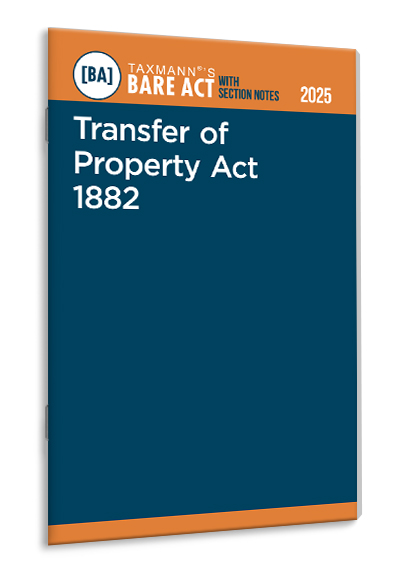
Taxmann s Transfer of Property Act 1882
From Taxmann
Regular price
155.00 140.00
|Save:
15.00(10 %)
Tax included

SPENT 499 MORE FOR FREE SHIPPING
Expected Delivery Within 7 Working Days.

Description
Key Features of the Transfer of Property Act, 1882:
-
Definition of Transfer of Property (Section 5)
- The Act defines the transfer of property as the act of conveying property from one person to another.
- The transfer can be done by sale, mortgage, lease, exchange, or gift.
-
Types of Property Covered
- The Act applies to both movable and immovable property, but its main focus is on immovable property (land, buildings, etc.).
-
Who Can Transfer Property? (Section 7)
- Any person competent to contract (i.e., of sound mind and not a minor) can transfer property.
- The person transferring must have a legal right or authority over the property.
-
Types of Transfer
- Sale (Section 54) – Permanent transfer of ownership in exchange for money.
- Mortgage (Section 58) – Property is used as security for a loan.
- Lease (Section 105) – Temporary transfer of property for a specific time in return for rent.
- Gift (Section 122) – Transfer of property without consideration (without taking money).
- Exchange (Section 118) – Transfer of one property for another.
-
Conditions and Limitations
- The transfer must be done legally, with clear ownership rights.
- Certain properties cannot be transferred, such as rights of future maintenance or a mere right to sue (Section 6).
- Property transfers should be made voluntarily and without coercion.
-
Doctrine of Part Performance (Section 53A)
- Protects a buyer who has taken possession of a property under an agreement but has not yet received legal ownership.
-
Doctrine of Election (Section 35)
- If a person benefits from a property transfer but also has an obligation in the same transfer, they must either accept both or reject both.
Applicability
- The Act applies across India but does not cover certain property transfers governed by Muslim Personal Law or customary laws.
Significance
The Transfer of Property Act, 1882, is crucial in defining legal property rights and ensuring fair transactions. It helps avoid disputes by providing clear rules on how property should be transferred between individuals.
Size Guide
Shipping & Return
Please Follow Lawmart Shipping & Delivery Policy - https://www.lawmart.in/shipping_delivery.php
Please Follow Lawmart Return & Cancellation Policy - https://www.lawmart.in/return_cancellation.php
Content
Structure of the Transfer of Property Act, 1882
The Act is divided into two parts:
- General Principles (Sections 1–37) – Applies to all types of property transfers.
- Special Transfers (Sections 38–137) – Covers specific types of transfers like sale, mortgage, lease, exchange, and gift.
Key Provisions of the Transfer of Property Act, 1882
1. Preliminary (Sections 1–4)
- Section 1 – Short title, commencement, extent, and applicability.
- Section 2 – The Act does not apply to testamentary transfers (wills), Hindu and Muslim personal laws.
- Section 3 – Defines key terms like "immovable property," "instrument," "attached to the earth," etc.
- Section 4 – Relation of TPA with the Indian Contract Act, 1872.
2. General Principles of Transfer of Property (Sections 5–37)
Definition of Transfer
- Section 5 – Defines "transfer of property" as the conveyance of property from one living person to another.
- Section 6 – Specifies what property can and cannot be transferred (e.g., right to future maintenance, right to sue, public office).
Who Can Transfer Property
- Section 7 – A person must be competent to contract and have the right to transfer.
How Transfers Are Made
- Section 8 – A transfer conveys all legal rights, title, and interests unless otherwise stated.
- Section 9 – A transfer may be oral, except where a written document is required by law.
Conditional Transfers
- Section 10 – Prohibits absolute restrictions on transfer.
- Section 11 – Conditional interest is valid but cannot take away the enjoyment of the property.
- Section 12 – Property cannot be transferred absolutely to a person who is unborn or unable to inherit.
Doctrine of Election
- Section 35 – If a person accepts a benefit under a document, they must also accept any obligations imposed by it.
Fraudulent Transfers
- Section 53 – Protects creditors from fraudulent transfers made to defeat their claims.
3. Specific Types of Transfers (Sections 38–137)
Sale of Immovable Property (Sections 54–57)
- Section 54 – Defines sale as the transfer of ownership in exchange for a price.
- If the value is above ?100, it must be registered.
- Section 55 – Rights and duties of the buyer and seller.
Mortgage of Property (Sections 58–104)
- Section 58 – Defines mortgage as the transfer of an interest in immovable property for securing a loan.
- Types of Mortgages:
- Simple mortgage – Ownership remains with the borrower.
- Mortgage by conditional sale – Ownership passes to the lender if repayment is not made.
- Usufructuary mortgage – Lender takes possession and earns income from the property.
- English mortgage – Complete transfer with a condition to return upon repayment.
- Anomalous mortgage – Any mortgage that doesn’t fall under the above types.
Leases of Immovable Property (Sections 105–117)
- Section 105 – Defines lease as the transfer of a right to enjoy property for a specified period in exchange for rent.
- Section 108 – Rights and liabilities of lessor and lessee.
Exchanges (Sections 118–121)
- Section 118 – Defines exchange as the mutual transfer of ownership between two persons.
- Section 119 – Rights of parties in case of defective title in exchange.
Gifts (Sections 122–129)
- Section 122 – Defines gift as the transfer of property without consideration.
- Section 123 – A gift of immovable property must be registered.
- Section 126 – A gift may be revoked under certain conditions.
Doctrine of Part Performance (Section 53A)
- Protects a buyer who has taken possession under an agreement, even if the legal transfer is incomplete.
More Information
Product Summary
| Taxmann s Transfer of Property Act 1882 |
Review
Please Login to Submit Review.
Recently Viewed Products

HOT
10% Off

HOT
5% Off

HOT
50% Off
Size Guide
Ready to Wear Clothing


Lawmart is The One-Stop Destination for Legal Professionals
Lawmart - India's Largest Online Law Store Offering a Wide Range of Bare Acts, Law Books, Taxation Books, Academic Books, Journals, Legal Apparels and Legal Accessories Online. Get Amazing Discounts and Enjoy Fast Shipping as Well as Cash on Delivery at Our Online Store.
How to Buy Products From Lawmart?
First You Need to Log into Your Account With Your E-Mail id or Phone Number. Then We Will Send OTP. Once Your Account is Verified, Then You Need to Enter Your Name, Correct Address, E-Mail id and Phone Number in Your Account Section. After That You Can Order From Lawmart.

© 2022 Lawmart. All Rights Reserved.

Added to your shopping cart successfully.

Cushioned Office Chair
Color: Gray
1 X $113.88
Total: $113.88
Title
We were affected by the fire next door and will remain closed until further notice.
Close
