

Product Details Page

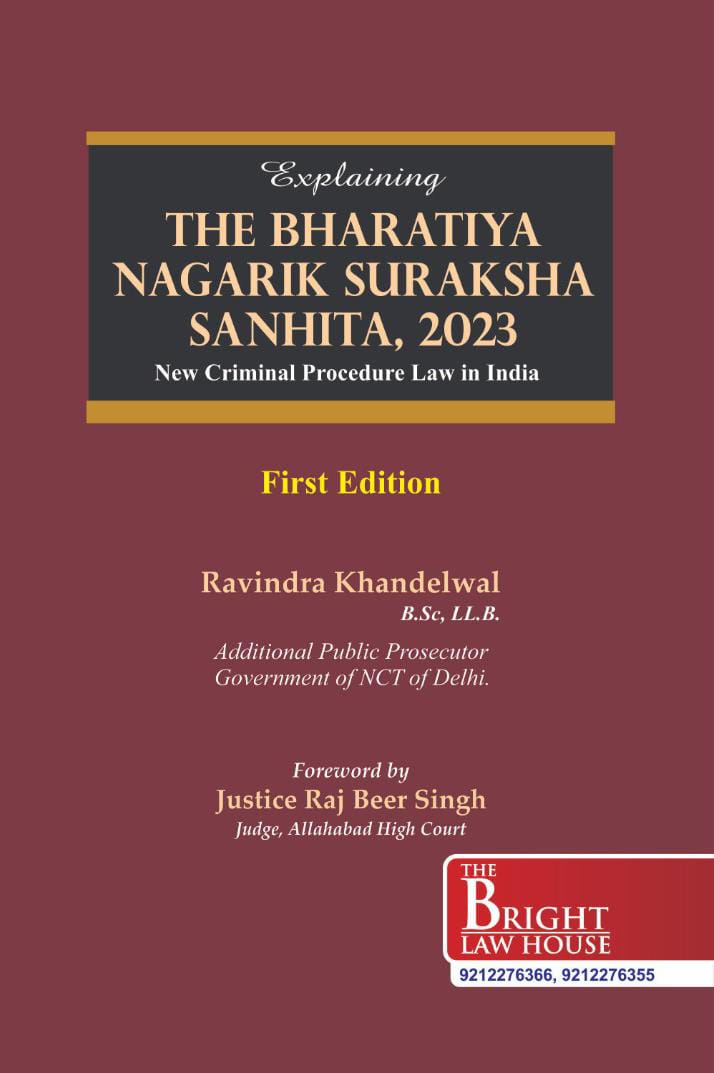
Ravindra Khandelwal Explaining The Bharatiya Nagarik Suraksha Sanhita, 2023
From The Bright Law House
Regular price
1400.00 1260.00
|Save:
140.00(10 %)
Tax included

SPENT 499 MORE FOR FREE SHIPPING
Expected Delivery Within 7 Working Days.

Description
Explaining The Bharatiya Nagarik Suraksha Sanhita, 2023
A Practical Guide to India’s Reformed Criminal Procedure Code
Explaining The Bharatiya Nagarik Suraksha Sanhita, 2023 is a comprehensive and reader-friendly commentary on India’s newly enacted criminal procedure law, which replaces the Code of Criminal Procedure, 1973 (CrPC). This book provides a section-wise explanation of the Bharatiya Nagarik Suraksha Sanhita (BNSS), 2023, making it an essential tool for understanding the procedural backbone of India’s modern criminal justice system.
Tailored for judges, lawyers, police officers, prosecutors, students, and policy professionals, this guide covers all aspects of the criminal process—from registration of FIR to trial, bail, evidence, appeal, and execution of sentences—reflecting the latest legal reforms and procedural safeguards.
Key Features:
-
Section-wise commentary on all 531 sections of the BNSS, 2023
-
Comparative analysis with the Code of Criminal Procedure, 1973
-
In-depth focus on digitization, timelines, victims' rights, forensic procedures, and electronic evidence
-
Practical insights into arrest, bail, investigation, trial, plea bargaining, and summary procedures
-
Includes case law references, flowcharts, and practice tips
-
Essential for criminal law practitioners, academicians, and students preparing for judicial and competitive exams
Size Guide
Shipping & Return
Please Follow Lawmart Shipping & Delivery Policy - https://www.lawmart.in/shipping_delivery.php
Please Follow Lawmart Return & Cancellation Policy - https://www.lawmart.in/return_cancellation.php
Content
Part I – Introduction to the BNSS, 2023
-
Background and Legislative Purpose
-
Repeal of the Code of Criminal Procedure, 1973
-
Need for reform and modernization
-
Objectives and salient features of BNSS
-
-
Structural Overview of BNSS, 2023
-
Chapters and total number of sections
-
Key procedural themes
-
Definitions and scope
-
-
Comparative Table: BNSS, 2023 vs. CrPC, 1973
-
Side-by-side mapping of old and new sections
-
Repealed, revised, and newly added provisions
-
Part II – Chapter-wise Commentary on BNSS, 2023
Chapter 1: Preliminary (Sections 1–3)
-
Short title, extent, commencement
-
Key definitions (e.g., electronic communication, digital evidence, victim, arrest)
Chapter 2: Constitution of Criminal Courts and Offices (Sections 4–23)
-
Classification of criminal courts
-
Powers and jurisdiction
Chapter 3: Powers of Courts (Sections 24–27)
-
Sentencing powers and conferred authorities
Chapter 4: Aid to Magistrates and Police (Sections 28–31)
Part III – Pre-Trial Process
Chapter 5: Arrest and Processes (Sections 32–90)
-
Arrest procedures with and without warrant
-
Notice of appearance and handcuffing restrictions
-
New safeguards for women, children, and vulnerable persons
-
Police custody timelines (15 to 90 days)
Chapter 6: Information to Police & Investigation (Sections 91–171)
-
FIR registration (including e-FIR)
-
Preliminary inquiry provisions
-
Role of forensic teams
-
Timeline for investigation completion
Chapter 7: Jurisdiction and Cognizance (Sections 172–193)
-
Trial jurisdiction of Magistrates and Sessions Courts
-
Cognizance of offences by courts
Part IV – Trial and Court Proceedings
Chapter 8: Commencement of Proceedings (Sections 194–208)
-
Complaints, summons, and warrants
-
Service of summons via electronic means
Chapter 9: Bail and Bonds (Sections 209–227)
-
Bailable and non-bailable offences
-
Default bail provisions
-
Bail for undertrial prisoners
Chapter 10: Disposal of Cases Without Trial (Sections 228–242)
-
Plea bargaining
-
Summary trials and compounding of offences
Chapter 11: Charge and Trial (Sections 243–312)
-
Framing of charges
-
Separate and joint trials
-
Trial procedures in warrant, summons, and sessions cases
-
Fast-track timelines
Part V – Evidence and Witnesses
Chapter 12: Evidence in Inquiries and Trials (Sections 313–345)
-
Production and marking of documents
-
Use of video-conferencing for evidence
-
Protection and examination of witnesses
-
Electronic evidence admissibility
Part VI – Judgment and Sentencing
Chapter 13: Judgment and Execution (Sections 346–374)
-
Pronouncement and content of judgments
-
Compensation to victims
-
Sentence execution procedures
Part VII – Appeals and Reference
Chapter 14: Appeals, Review and Revision (Sections 375–423)
-
Right to appeal
-
Victim’s right to appeal against acquittal
-
Revision and reference to higher courts
Part VIII – Preventive and Security Measures
Chapter 15–17: Preventive Actions (Sections 424–466)
-
Security for keeping peace
-
Preventive arrest
-
Maintenance of public order
Part IX – Maintenance and Public Nuisance
Chapter 18–19 (Sections 467–495)
-
Maintenance of wives, children, and parents
-
Public nuisance and urgent cases
Part X – Miscellaneous Provisions
Chapter 20–25 (Sections 496–531)
-
Provisions related to accused persons of unsound mind
-
Disposal of property
-
Irregular proceedings and limitation periods
-
Legal aid and victim rights
-
Transitional and repeal clauses
Part XI – Schedules and Forms
-
First Schedule: Classification of Offences
-
Second Schedule: Forms and Warrants
-
Third Schedule: Summary of Bailable/Non-Bailable, Cognizable/Non-Cognizable Offences
More Information
Product Summary
| Ravindra Khandelwal Explaining The Bharatiya Nagarik Suraksha Sanhita, 2023 |
Review
Please Login to Submit Review.
Recently Viewed Products

HOT
10% Off

HOT
5% Off

HOT
50% Off
Size Guide
Ready to Wear Clothing


Lawmart is The One-Stop Destination for Legal Professionals
Lawmart - India's Largest Online Law Store Offering a Wide Range of Bare Acts, Law Books, Taxation Books, Academic Books, Journals, Legal Apparels and Legal Accessories Online. Get Amazing Discounts and Enjoy Fast Shipping as Well as Cash on Delivery at Our Online Store.
How to Buy Products From Lawmart?
First You Need to Log into Your Account With Your E-Mail id or Phone Number. Then We Will Send OTP. Once Your Account is Verified, Then You Need to Enter Your Name, Correct Address, E-Mail id and Phone Number in Your Account Section. After That You Can Order From Lawmart.

© 2022 Lawmart. All Rights Reserved.

Added to your shopping cart successfully.

Cushioned Office Chair
Color: Gray
1 X $113.88
Total: $113.88
Title
We were affected by the fire next door and will remain closed until further notice.
Close
