

Product Details Page

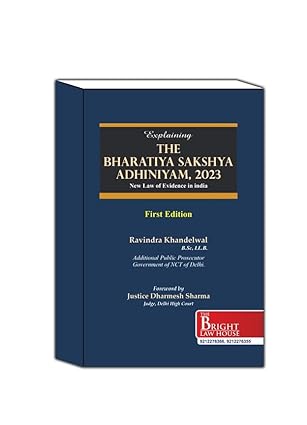
Ravindra Khandelwal Explaining The Bharatiya Sakshya Adhiniyam, 2023
From The Bright Law House
Regular price
1200.00 1080.00
|Save:
120.00(10 %)
Tax included

SPENT 499 MORE FOR FREE SHIPPING
Expected Delivery Within 7 Working Days.

Description
Explaining The Bharatiya Sakshya Adhiniyam, 2023
A Section-wise Guide to India’s New Law of Evidence
Explaining The Bharatiya Sakshya Adhiniyam, 2023 presents a clear, analytical, and structured commentary on India’s newly enacted law that replaces the colonial-era Indian Evidence Act, 1872. This book is designed to assist legal practitioners, judges, law enforcement officers, academicians, and students in understanding the new evidentiary framework under Indian law.
The book offers a section-wise explanation of the Bharatiya Sakshya Adhiniyam (BSA), 2023, with comparative references to the Indian Evidence Act. It explains new legal concepts, digital evidence admissibility, presumptions, burden of proof, and witness examination procedures, making it a vital resource during this legal transition.
Key Features:
-
Comprehensive section-by-section commentary on the Bharatiya Sakshya Adhiniyam, 2023
-
Includes comparative references to the Indian Evidence Act, 1872 for continuity and better understanding
-
Focus on electronic and digital evidence, including cloud storage, emails, and metadata
-
Practical insights into burden of proof, witness examination, and presumptions
-
Ideal for criminal and civil law practitioners, police officials, judicial officers, and law students
-
Up-to-date with the latest statutory provisions and legal interpretation tools
Size Guide
Shipping & Return
Please Follow Lawmart Shipping & Delivery Policy - https://www.lawmart.in/shipping_delivery.php
Please Follow Lawmart Return & Cancellation Policy - https://www.lawmart.in/return_cancellation.php
Content
Part I – Introduction to Bharatiya Sakshya Adhiniyam (BSA), 2023
-
Background and Legislative Intent
-
Why the Indian Evidence Act, 1872 was replaced
-
Objectives of the BSA, 2023
-
Key changes introduced
-
-
Structure of the Act
-
Overview of Chapters and Sections
-
Classification: Relevancy, Admissibility, Proof, and Witnesses
-
-
Comparative Table: BSA, 2023 vs Indian Evidence Act, 1872
-
Side-by-side comparison of section numbers and topics
-
Repealed, retained, and newly added provisions
-
Part II – Chapter-wise Commentary on BSA, 2023
Chapter I: Preliminary (Sections 1–2)
-
Title, application, and definitions
-
Important new definitions: digital records, electronic communication, etc.
Chapter II: Relevancy of Facts (Sections 3–30)
-
Facts connected with the issue
-
Motive, preparation, conduct, conspiracy
-
Admissions and confessions
-
Relevancy of statements made under special circumstances (dying declarations, expert opinions, etc.)
Chapter III: Admissions and Confessions (Sections 31–39)
-
Admissibility and exceptions
-
Judicial vs extra-judicial confessions
-
Confessions made to police or in custody
Chapter IV: Statements by Persons Who Cannot Be Called as Witnesses (Sections 40–45)
-
Hearsay exceptions
-
Relevance of documents made in the ordinary course of business
Chapter V: Relevancy of Judgments (Sections 46–49)
-
Judgments in rem and inter partes
-
Use of previous judgments in subsequent proceedings
Chapter VI: Expert Opinion and Character Evidence (Sections 50–52)
-
Expert opinions in science, handwriting, digital forensics
-
When character evidence is relevant
Part III – Documentary and Digital Evidence
Chapter VII: Documentary Evidence (Sections 53–63)
-
Primary vs secondary evidence
-
Public and private documents
-
Certified copies, official documents
Chapter VIII: Electronic and Digital Records (Sections 64–74)
-
Admissibility of electronic records
-
Presumptions relating to digital signatures, emails, cloud storage
-
Meta data, hash values, digital logs
Part IV – Burden of Proof and Presumptions
Chapter IX: Burden of Proof (Sections 75–88)
-
Who must prove what?
-
Presumptions of law and fact
-
Special rules in criminal and civil trials
Chapter X: Estoppel (Section 89)
-
When a party is precluded from denying facts
Part V – Witnesses and Examination
Chapter XI: Witnesses (Sections 90–102)
-
Competency and compellability of witnesses
-
Privileged communications
-
Hostile witnesses
Chapter XII: Examination of Witnesses (Sections 103–116)
-
Order of examination
-
Cross-examination and re-examination
-
Leading questions, impeaching credit
Chapter XIII: Improper Admission and Rejection of Evidence (Section 117)
-
When such error does or does not vitiate trial
Part VI – Implementation and Interpretation
-
Practical Application of BSA Provisions
-
Drafting evidence-related pleadings
-
Evidentiary value in digital-era litigation
-
Relevance in civil vs criminal cases
-
-
FAQs and Common Pitfalls
-
Admissibility vs relevancy
-
Role of electronic evidence in trial courts
-
-
Landmark Case References
-
Summaries of leading judgments (under IPC and anticipated under BNS)
-
Constitutional framework of the law of evidence
-
More Information
Product Summary
| Ravindra Khandelwal Explaining The Bharatiya Sakshya Adhiniyam, 2023 |
Review
Please Login to Submit Review.
Recently Viewed Products

HOT
10% Off

HOT
5% Off

HOT
50% Off
Size Guide
Ready to Wear Clothing


Lawmart is The One-Stop Destination for Legal Professionals
Lawmart - India's Largest Online Law Store Offering a Wide Range of Bare Acts, Law Books, Taxation Books, Academic Books, Journals, Legal Apparels and Legal Accessories Online. Get Amazing Discounts and Enjoy Fast Shipping as Well as Cash on Delivery at Our Online Store.
How to Buy Products From Lawmart?
First You Need to Log into Your Account With Your E-Mail id or Phone Number. Then We Will Send OTP. Once Your Account is Verified, Then You Need to Enter Your Name, Correct Address, E-Mail id and Phone Number in Your Account Section. After That You Can Order From Lawmart.

© 2022 Lawmart. All Rights Reserved.

Added to your shopping cart successfully.

Cushioned Office Chair
Color: Gray
1 X $113.88
Total: $113.88
Title
We were affected by the fire next door and will remain closed until further notice.
Close
